Rishena 10K UHF, Closed-Loop SCS Enables Cutting-Edge SCS Applications | Literature Sharing
From: News Date: 2026-09-04 14:12Recently, the team of Directors Wende Li, Xu Zeng, and Xiaoyu Xia from the Department of Neurosurgery, the Seventh Medical Center of the Chinese PLA General Hospital, published a review titled “Innovative Applications of Spinal Cord Stimulation in the Field of Neural Repair” in the August 2026 issue of Journal of Clinical Neurosurgery. The article systematically reviews the paradigm shift of SCS from “palliative treatment for refractory pain” to “active neural functional repair and reconstruction,” providing a clear framework for clinical translation in spinal cord injury, post-stroke rehabilitation, diabetic peripheral neuropathy, and other fields.
·Review·
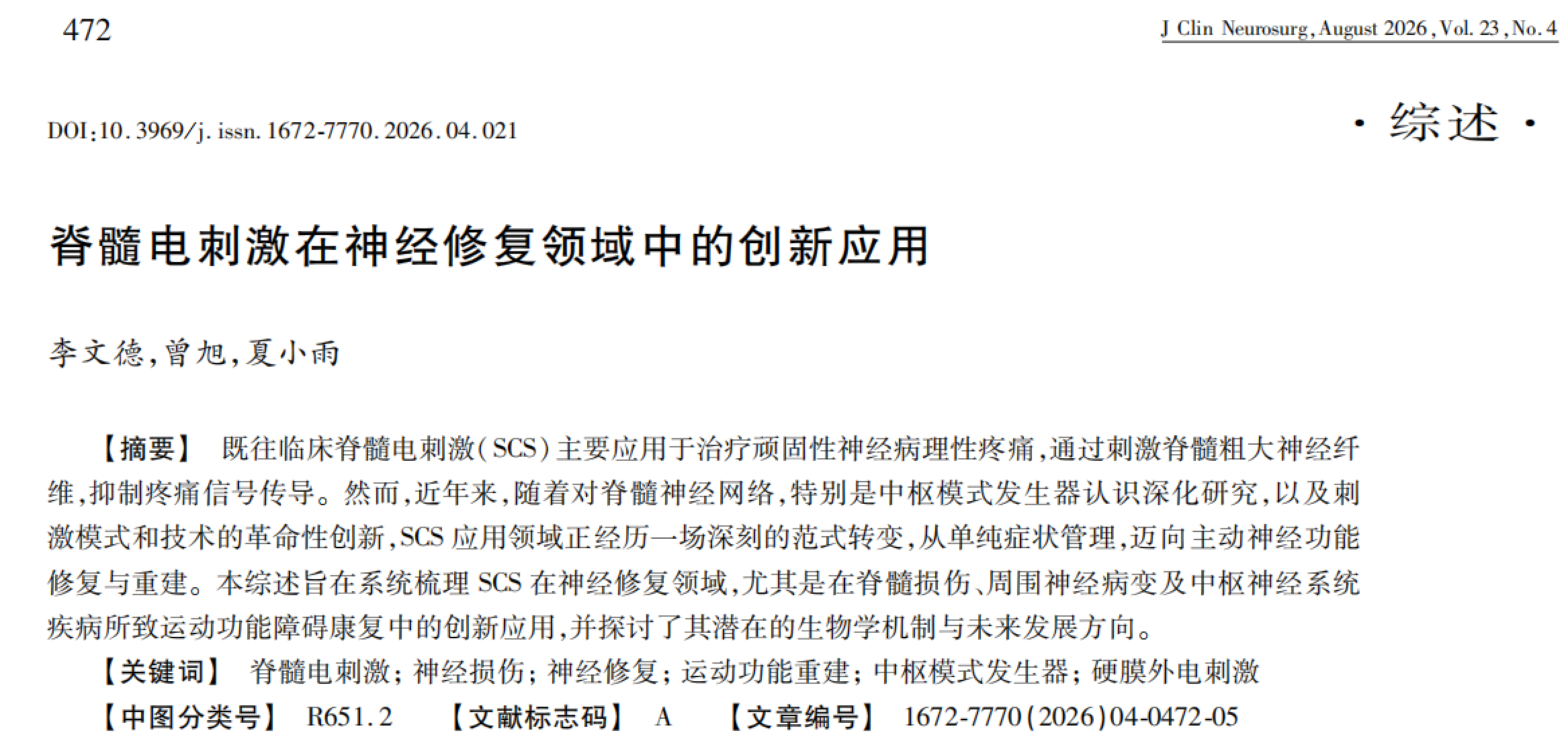
Innovative Applications of Spinal Cord Stimulation in the Field of Neural Repair
Wende Li, Xu Zeng, Xiaoyu Xia
Abstract: Historically, clinical spinal cord stimulation (SCS) was mainly used to treat refractory neuropathic pain by stimulating large myelinated fibers of the spinal cord and inhibiting pain signal transmission. However, in recent years, with deeper understanding of spinal cord neural networks—especially the central pattern generator (CPG)—and revolutionary innovations in stimulation patterns and techniques, the application of SCS is undergoing a profound paradigm shift, moving from mere symptom management to active neural functional repair and reconstruction. This review aims to systematically outline the innovative applications of SCS in neural repair, particularly in motor dysfunction rehabilitation caused by spinal cord injury, peripheral neuropathy, and central nervous system diseases, and discusses its potential biological mechanisms and future directions.
Keywords: spinal cord stimulation; neural injury; neural repair; motor function reconstruction; central pattern generator; epidural electrical stimulation
Chinese Library Classification: R651.2 Document Code: A Article ID: 1672-7770(2026)04-0472-05]
Quick Overview of Core Findings
Since its clinical introduction in 1965 based on the “pain gate control theory,” spinal cord stimulation (SCS) was long regarded as an analgesic tool. But with breakthroughs in spinal cord neural network research (especially the central pattern generator, CPG) and the emergence of new technologies such as 10 kHz high-frequency, burst, and closed-loop SCS, its positioning is being redefined:
· Beyond analgesia: By activating CPG and upregulating BDNF/TrkB and cAMP/PKA pathways, it promotes synaptic plasticity and axonal regeneration.
· Toward functional reconstruction: Positive signals have appeared in lower-limb motor recovery after spinal cord injury, upper-limb function after stroke, and coma arousal.
· Precision upgrade: Precise targeting of specific spinal segments; stimulation evolves from open-loop to ECAP closed-loop and AI adaptive control.
1. Why SCS Can “Repair” Rather Than Just “Block”
The review points out that the neural repair effect of SCS is superimposed by three layers of mechanisms:
· Classic gating: Stimulating dorsal column Aβ fibers to inhibit upward pain transmission.
· Circuit awakening: Electrical pulses provide excitatory afferent input to the ventral horn CPG, enabling the re-expression of rhythmic movements such as stepping and flexion–extension below the injury level.
· Molecular plasticity: Activating Wnt/β-catenin, BDNF-TrkB, and cAMP/PKA to induce LTP/LTD-like synaptic remodeling, and improving local microcirculation and the inflammatory microenvironment.
2. Different Segment Electrodes Correspond to Different Repair Targets
The review compiles a clinically direct “segment–disease” mapping table:
· Cervical C3–C7: Upper-limb function in stroke / tetraplegia; modulates corticospinal tract
· Thoracic T2–T4: Gait disorder in Parkinson’s disease; modulates cortico-basal-thalamic oscillation
· Thoracic T9–T10: Low back pain / lower-limb pain; gate-control analgesia
· Thoracic T11–T12: Lower-limb motor reconstruction in thoracolumbar SCI; activates CPG
· Lumbosacral L1–S2: Diabetic peripheral neuropathy; improves circulation and neural repair
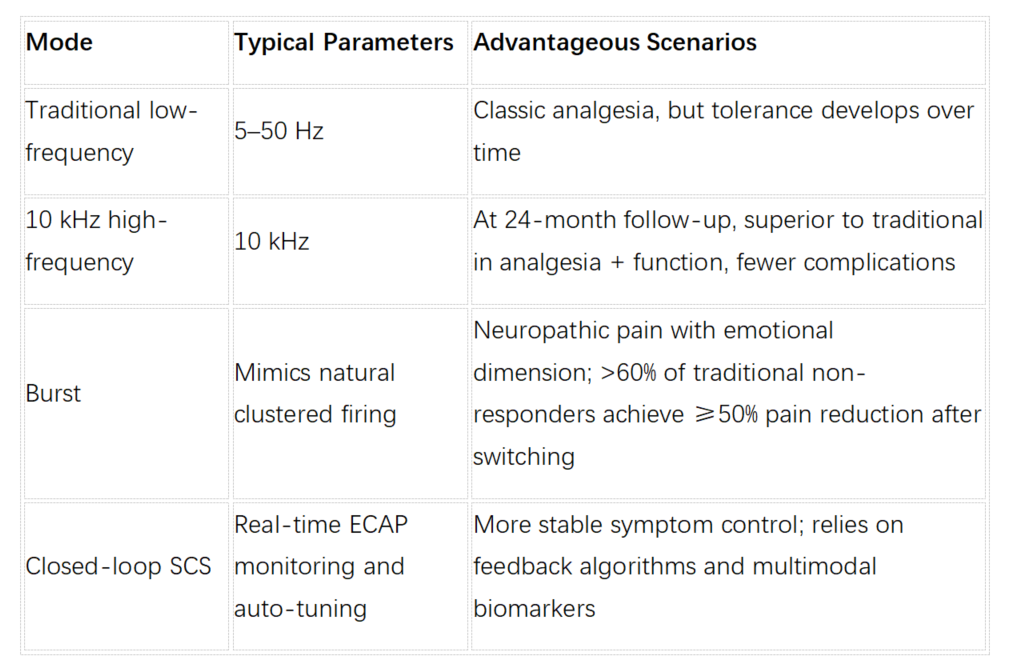
3. Innovative Stimulation Modes: From “Any Electricity Works” to “Waveform Is the Drug”
[Image:
4. Application Directions in Neural Repair
· Spinal cord injury: Epidural SCS + brain–computer interface has achieved fine finger grasping in chronic tetraplegic patients; thoracic SCS + intensive gait training significantly improves walking speed and endurance in AIS C patients.
· Diabetic peripheral neuropathy: 10 kHz SCS shows 90.1% pain relief rate and 65.5% neurological recovery rate at 24 months, and accelerates foot ulcer healing.
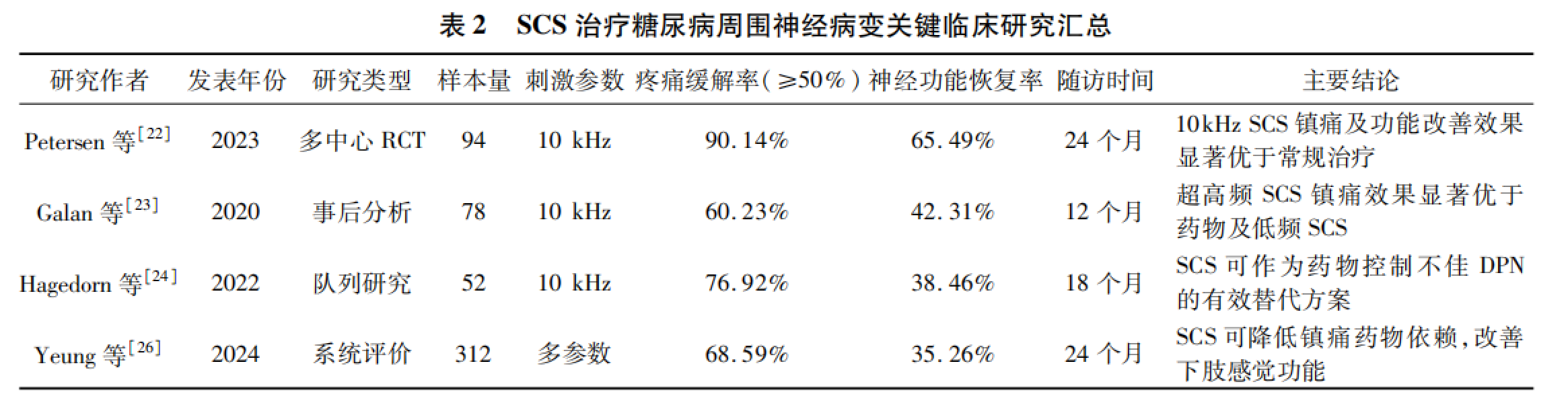
Table 2 Summary of key clinical studies on SCS in diabetic peripheral neuropathy
| Author | Year | Study type | Sample | Parameters | Pain relief ≥50% | Neuro recovery | Follow-up | Conclusion |
| Petersen | 2023 | Multicenter RCT | 94 | 10 kHz | 90.14% | 65.49% | 24 mo | 10 kHz SCS significantly better than usual care |
| Galan et al. | 2020 | Post-hoc analysis | 78 | 10 kHz | 60.23% | 42.31% | 12 mo | Ultra-high-frequency SCS superior to drugs/low-freq |
| Hagedorn et al. | 2022 | Cohort | 52 | 10 kHz | 76.92% | 38.46% | 18 mo | SCS viable alternative for refractory DPN |
| Yeung et al. | 2024 | Systematic review | 312 | Multi-param | 68.59% | 35.26% | 24 mo | Reduces analgesic dependence, improves sensation |]
· Chemotherapy-induced peripheral neuropathy: >50% pain relief, improved vibration/tactile thresholds, partial promotion of damaged nerve repair.
· Chronic disorders of consciousness: After SCS, frontal α/θ/δ sample entropy increases, suggesting enhanced cortical information integration (but lacking large-sample CRS-R behavioral endpoints).
· Parkinson’s disease: Thoracic SCS shows small-sample improvement in freezing of gait; evidence level still low.
· Post-stroke rehabilitation: Cervical SCS enhances corticospinal drive; China issued Expert Consensus on SCS for Post-Stroke Hemiplegia (2025).
· Others: Cerebral palsy, epilepsy, spinocerebellar ataxia, etc.
5. Summary and Outlook
Spinal cord stimulation (SCS) is shifting from pain management to active neural functional repair. By regulating neuronal electrical activity, promoting neural plasticity, and modulating the central pattern generator, it has shown potential in post-SCI motor reconstruction, diabetic peripheral neuropathy, and stroke rehabilitation.
Current challenges: Mechanistic understanding remains largely phenomenological without causal validation; most studies are small-sample with limited evidence strength.
Future directions: Mechanistically, use optogenetics and single-cell sequencing to validate circuit regulation; technically, optimize closed-loop feedback algorithms, renew electrode design, and develop AI-adaptive waveforms for individualized precise control; clinically, urgently conduct large-scale multicenter RCTs and establish standardized guidelines and patient screening criteria.
References:
[1] Li W, Zeng X, Xia X. Innovative applications of spinal cord stimulation in the field of neural repair [J]. Journal of Clinical Neurosurgery, 2026, 23(4): 472-476.
Expert Profiles
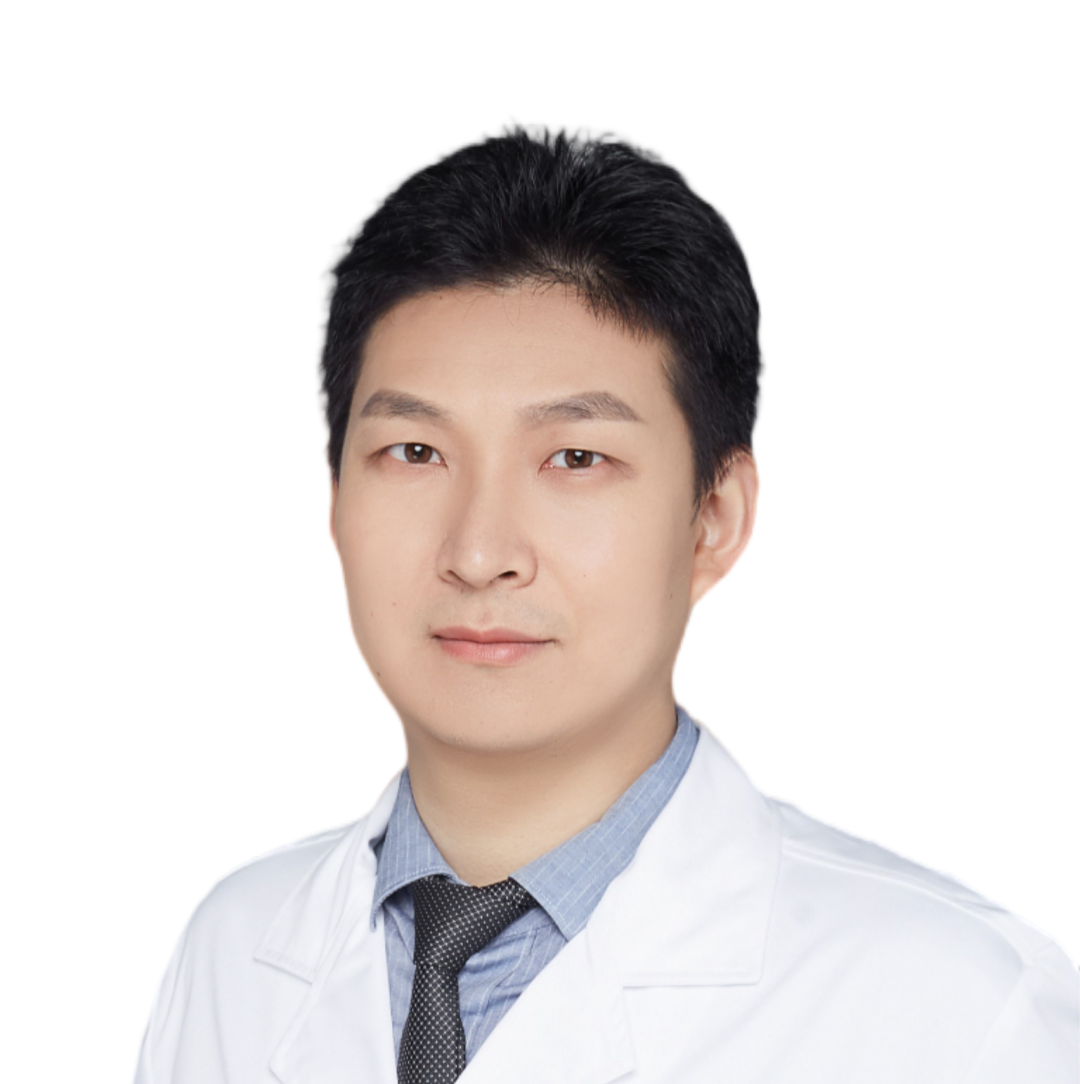
Xiaoyu Xia
MD (PUMC 8-year program), PhD
Associate Chief Physician, Department of Neurosurgery, Chinese PLA General Hospital
MD-PhD from Peking Union Medical College, postdoctoral fellow in Dept. of Biomedical Engineering, Tsinghua University School of Medicine; reviewer for Frontiers in Neurology.
Specialties: Comprehensive management for coma (vegetative state) arousal; neuromodulation for functional disorders including DBS for Parkinson’s, SCS for spinal cord injury, SCS/drug pump for severe pain, VNS for refractory epilepsy and post-stroke rehab, sacral nerve stimulation for bladder/bowel dysfunction.
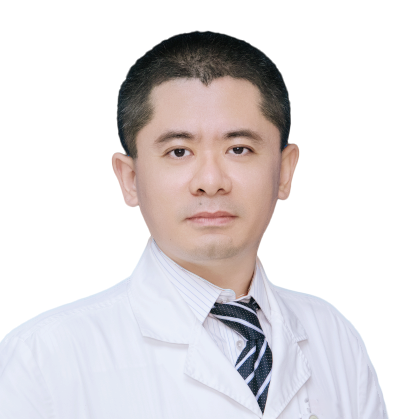
Wende Li
MD (Peking Univ. 8-year program), PhD
Department of Neurosurgery, Chinese PLA General Hospital
Clinic: Friday AM, Neural Repair Clinic, 7th Medical Center East Bldg 2F A9
2002-entry PKU Health Science Center 8-yr MD-PhD; 31 papers (25 core CN, 6 SCI); 6 books; 5 national/provincial projects.
Specialties: SCI (paraplegia/tetraplegia, bladder/bowel, neuropathic pain, spasticity); TBI/stroke sequelae; chronic pain (diabetic, post-herpetic, postoperative); brachial plexus injury, cerebellar gait, bladder/bowel dysfunction.
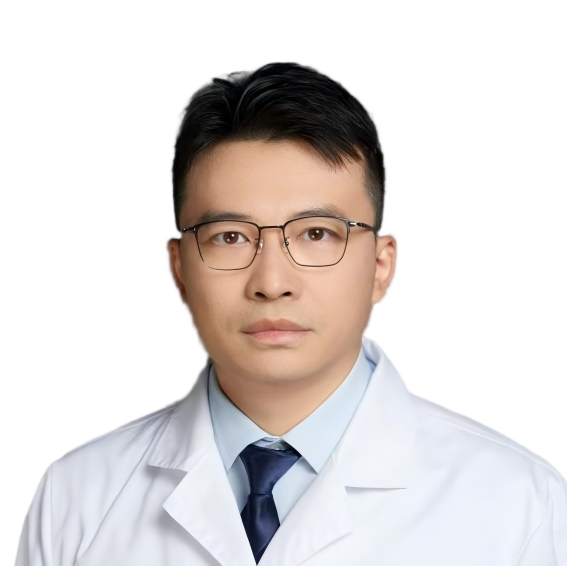
Xu Zeng
MD (PUMC 8-year program), PhD
Pediatric Neurosurgery, Chinese PLA General Hospital
Clinic: Friday AM, Pediatric Spine-Spinal Cord Clinic, 7th Medical Center Pediatric Outpatient 103
PUMC 8-yr clinical PhD; 3 national/provincial/military projects; 5 SCI papers.
Specialties: Pediatric neurosurgery (trauma, vascular malformation, tumor, hydrocephalus, neural tube defects, craniosynostosis); spine-spinal cord injury, tethered cord; TBI and post-TBI hydrocephalus/infection/coma arousal.
Contact


